
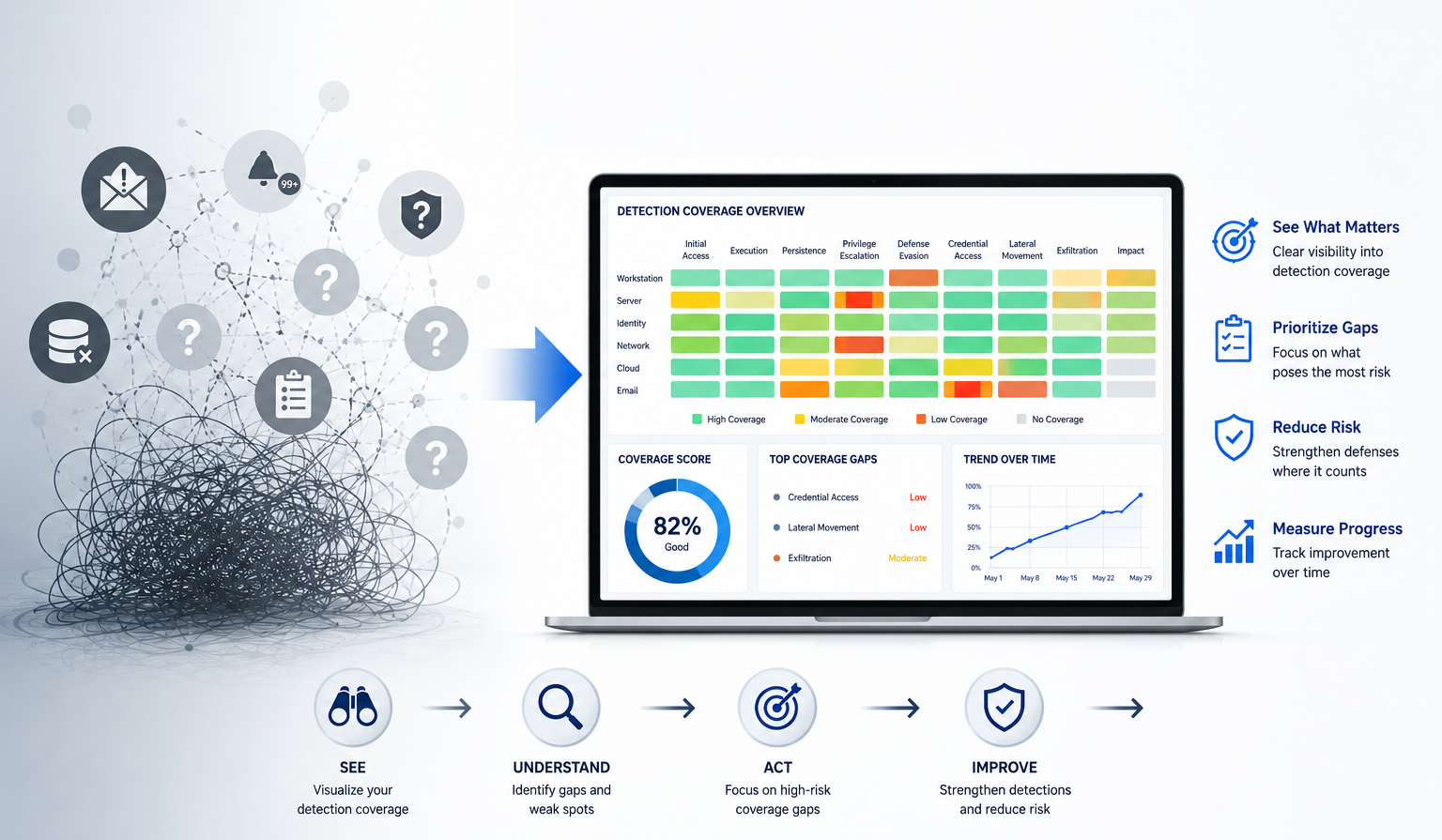
In today's threat landscape, Security Operations Centers (SOCs) collect more security data than ever before. Endpoint Detection and Response (EDR), Identity Providers (IdPs), firewalls, cloud platforms, SaaS applications, DNS logs, email gateways, vulnerability scanners, and threat intelligence feeds continuously generate massive volumes of telemetry.
Yet despite this abundance of data, many SOCs still struggle with one critical problem:
They lack visibility into what attackers are actually doing.
The issue isn't the amount of data; it's the inability to transform telemetry into meaningful security visibility.
This article explores why SOC visibility remains one of the biggest operational challenges and provides practical strategies to improve it.
What SOC Visibility Really Means
SOC visibility is the ability to observe, detect, investigate, and understand malicious activity across an organization's entire attack surface.
True visibility answers questions such as:
- Can we see an attacker before they achieve their objective?
- Which MITRE ATT&CK techniques are detectable?
- Where do our logging blind spots exist?
- Which assets generate no security telemetry?
- Which attacks would bypass our existing detections?
Visibility is not measured by:
- Number of SIEM events
- Number of dashboards
- Number of alerts
- Log storage capacity
Instead, it is measured by how much attacker behavior can be observed.
Why Most SOCs Have Poor Visibility
1. Logging Does Not Equal Visibility
Many organizations believe that sending every possible log to the SIEM automatically creates visibility.
Unfortunately, it does not.
Consider this example:
A SOC ingests:
- Windows Event Logs
- Firewall logs
- Microsoft 365 logs
- EDR telemetry
- Azure Activity Logs
This may generate billions of events each month.
However, if none of those logs can detect:
- Credential dumping
- Pass-the-Hash
- Kerberoasting
- Living-off-the-land attacks
then the SOC has data, but not visibility.
More logs without context simply create more noise.
2. Detection Coverage is Incomplete
Many SOCs build detection rules based on:
- Vendor recommendations
- Compliance requirements
- Existing use cases
- Historical incidents
Rarely do they ask:
Which ATT&CK techniques are still completely undetected?
Without measuring detection coverage, organizations unknowingly leave large portions of the attack lifecycle invisible.
Examples include:
- Discovery
- Lateral movement
- Defense evasion
- Credential access
- Persistence
Attackers naturally exploit these blind spots.
3. Security Tools Operate in Silos
Visibility becomes fragmented when every security tool operates independently.
Examples include:
- SIEM
- EDR
- Cloud Security
- Identity Monitoring
- Email Security
- Network Detection and Response (NDR)
- Vulnerability Management
Each tool sees only a portion of the attack.
Without correlation, analysts investigate isolated alerts instead of understanding the complete intrusion.
A phishing email may appear unrelated to:
- Azure sign-in anomalies
- Endpoint PowerShell execution
- Firewall traffic
- Privilege escalation
In reality, they are often stages of the same attack.
4. Cloud Visibility is Often Limited
Modern organizations increasingly rely on:
- Microsoft Azure
- AWS
- Google Cloud
- Microsoft 365
- Salesforce
- ServiceNow
- Okta
Traditional SOCs were designed around on-premises infrastructure.
As a result, cloud telemetry is often:
- Under-collected
- Misconfigured
- Not normalized
- Missing entirely
Critical attacker actions may never reach the SIEM.
5. Identity Visibility is Inadequate
Modern attacks increasingly target identities rather than endpoints.
Examples include:
- MFA fatigue
- Token theft
- OAuth abuse
- Conditional Access bypass
- Privilege escalation
- Service account compromise
Many SOCs continue to prioritize endpoint visibility while lacking comprehensive identity monitoring.
Since identity is often the new security perimeter, this creates significant blind spots.
6. Unknown Assets Cannot Be Monitored
You cannot monitor assets you do not know exist.
Common examples include:
- Shadow IT
- Unmanaged laptops
- Test servers
- Forgotten cloud subscriptions
- Development environments
- Third-party applications
These systems frequently operate without:
- Logging
- EDR
- Vulnerability scanning
- Security monitoring
Attackers actively search for these overlooked assets.
7. Alert-Centric Operations
Many SOCs measure success by:
- Alerts closed
- Mean Time to Respond (MTTR)
- Ticket counts
- SLA compliance
While operational metrics are important, they do not indicate whether the organization is actually observing attacker behavior.
A SOC can close thousands of alerts while remaining blind to sophisticated attacks.
The Hidden Cost of Poor Visibility
Poor visibility impacts far more than detection.
It leads to:
- Longer dwell times
- Higher incident response costs
- Missed ransomware activity
- Compliance gaps
- Inaccurate risk assessments
- Increased analyst fatigue
- Greater business disruption
Perhaps most concerning, organizations may believe they are well protected because they rarely detect serious attacks when in reality, they simply lack the visibility to see them.
Building Better SOC Visibility
Improving visibility requires a strategic approach rather than simply deploying additional security tools.
1. Build an ATT&CK-Aligned Visibility Matrix
Map every detection to the MITRE ATT&CK framework.
Identify:
- Covered techniques
- Partially covered techniques
- Unsupported techniques
- High-risk visibility gaps
This transforms visibility into something measurable.
2. Focus on High-Value Telemetry
Not every log provides equal value.
Prioritize telemetry from:
- Identity providers
- EDR platforms
- DNS
- Active Directory
- Microsoft 365
- Cloud audit logs
- VPN
- Privileged Access Management
- Email gateways
Collect telemetry that supports meaningful detections rather than maximizing log volume.
3. Continuously Validate Detection Coverage
Use techniques such as:
- Purple Team exercises
- MITRE ATT&CK emulation
- Detection engineering
- Adversary simulations
- Atomic Red Team testing
- Breach and Attack Simulation (BAS)
These exercises reveal which attacker behaviors remain invisible.
4. Correlate Across Multiple Security Domains
Effective visibility combines signals from:
- Endpoint
- Identity
- Network
- Cloud
- DNS
- SaaS
- Threat intelligence
Correlation enables analysts to reconstruct attack chains instead of responding to disconnected alerts.
5. Measure Visibility with Meaningful Metrics
Track metrics that reflect defensive capability, such as:
|
Metric |
Why It Matters |
|
ATT&CK Technique Coverage |
Measures detection completeness |
|
Log Source Health |
Confirms telemetry availability |
|
Asset Monitoring Coverage |
Ensures systems are observable |
|
Identity Monitoring Coverage |
Detects account-based attacks |
|
Detection Validation Rate |
Verifies rules perform as intended |
|
Mean Time to Detect (MTTD) |
Indicates detection effectiveness |
|
False Positive Rate |
Reflects alert quality |
|
Detection Gap Closure Rate |
Measures continuous improvement |
6. Treat Detection Engineering as a Core SOC Function
Detection engineering should be an ongoing capability—not an afterthought.
Mature teams:
- Develop custom detections
- Tune existing rules
- Remove obsolete alerts
- Validate new telemetry
- Test detections regularly
- Measure ATT&CK coverage
- Document detection logic
- Share lessons learned across teams
Continuous improvement strengthens visibility over time.
Characteristics of a Highly Visible SOC
Organizations with strong visibility typically demonstrate several common practices:
- Comprehensive telemetry from endpoint, identity, cloud, network, and SaaS environments.
- Detection coverage mapped to the MITRE ATT&CK framework and reviewed regularly.
- Continuous validation through adversary emulation, purple teaming, or automated attack simulation.
- Centralized correlation that connects related events across multiple security domains.
- Asset and identity inventories that ensure critical systems are monitored.
- A dedicated detection engineering function focused on expanding and improving visibility.
- Metrics that measure detection capability and coverage, not just alert volume.
These SOCs understand that visibility is a continuously evolving capability rather than a one-time implementation.
Final Thoughts
The most dangerous blind spot in cybersecurity is the one you don't know exists.
Many SOCs collect enormous amounts of telemetry yet remain unable to detect the attacker behaviors that matter most. Closing these gaps requires a shift from a log-centric mindset to a visibility-centric strategy; one built on quality telemetry, ATT&CK-aligned detection coverage, continuous validation, and strong detection engineering.
The organizations that succeed are not necessarily those with the largest security budgets or the most tools. They are the ones that continuously ask, "What can an attacker do today that we still cannot see?" Every identified blind spot becomes an opportunity to improve resilience, reduce attacker dwell time, and strengthen the SOC's ability to detect and respond before threats become business-impacting incidents.
Phelix Oluoch
Founder, PhelixCyber
W: PhelixCyber.com
